•
How Does Temperature Affect LLMs?
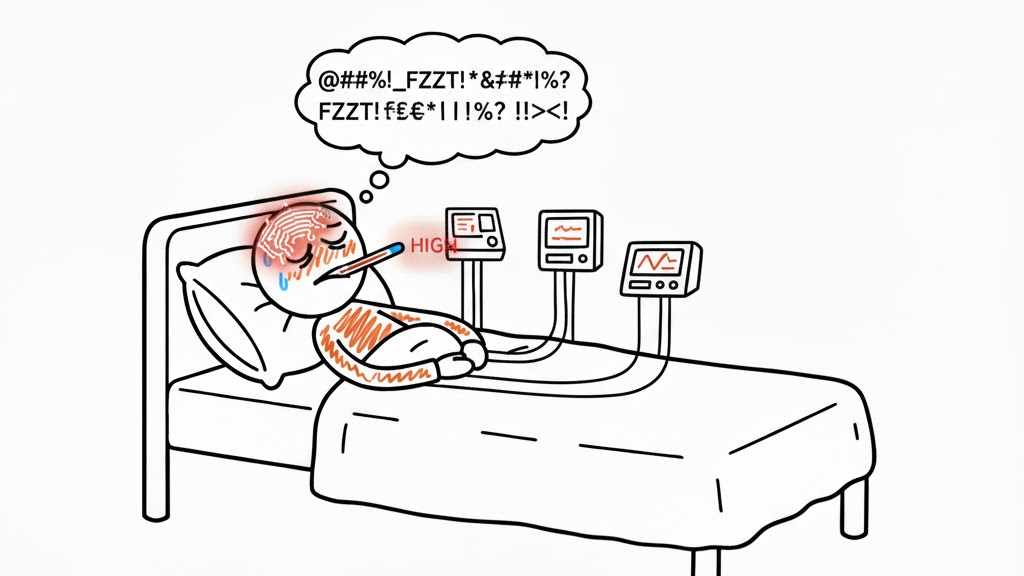
You've seen the temperature parameter everywhere. In playgrounds and model demos. In every "how to use an LLM" tutorial. In that engineering course you confidently bookmarked last month and promised yourself you'd finish.
Every explanation goes something like: "Higher temperature = more creative. Lower temperature = more predictable."
Cool. But why? What's actually happening inside the model?
Today we're going to find out. And it's more interesting than the one-liner suggests.
What Is Temperature in LLMs?
Let's start with the most obvious symptom.
A low temperature value produces identical responses from the LLM. Run the same prompt twice — get the same answer twice.
Python

Run it again. Same prompt, same temperature. You get the exact same response. Every. Single. Time.
But crank that temperature to 2, and things get... chaotic.
Python

That's not a bug. That's temperature working exactly as designed. The model isn't broken — it's very, very random.
So what's going on under the hood?
First, A Quick Detour: How Classification Models Work
Before we look at LLMs, let's revisit good old classification models.
Traditional classification models use softmax to convert raw logits into probabilities over all classes. In LLMs, the output layer spans the entire vocabulary — every possible token.
The difference is that a traditional classification model predicts the class with the highest softmax score, which makes it deterministic.
But LLMs sample the prediction from these softmax probabilities.
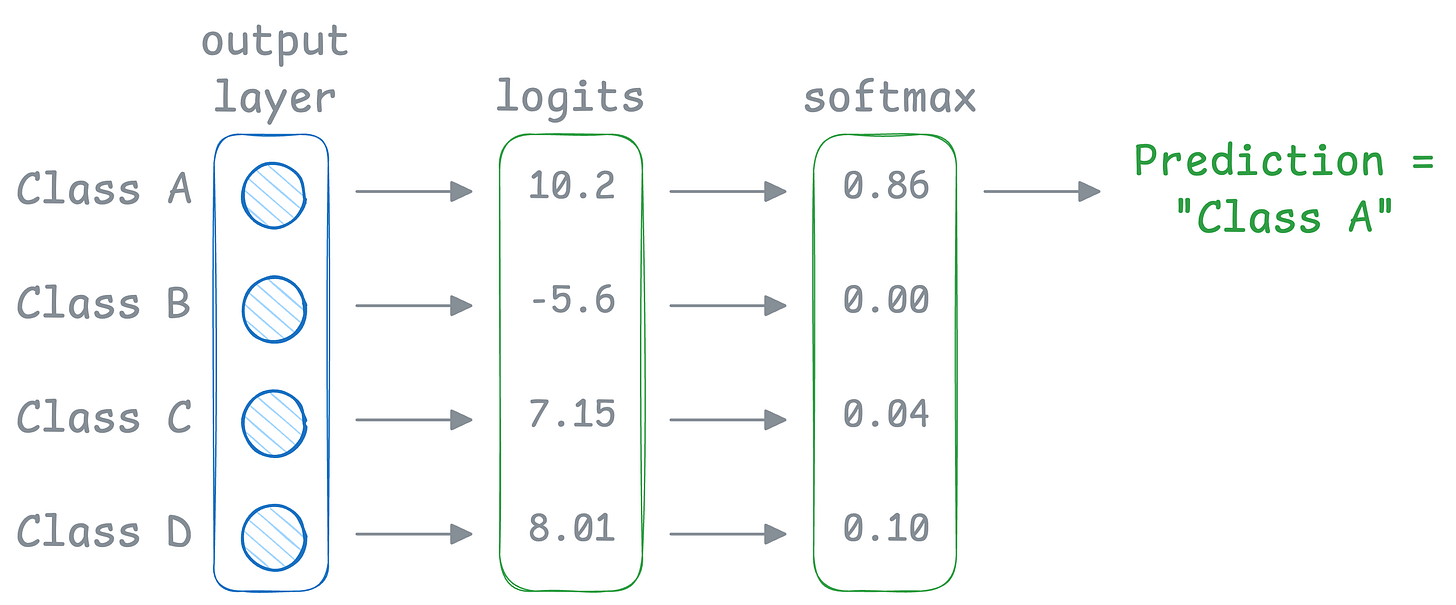
The difference is that a traditional classification model predicts the class with the highest softmax score — which makes it deterministic.
But LLMs sample the prediction from these softmax probabilities:
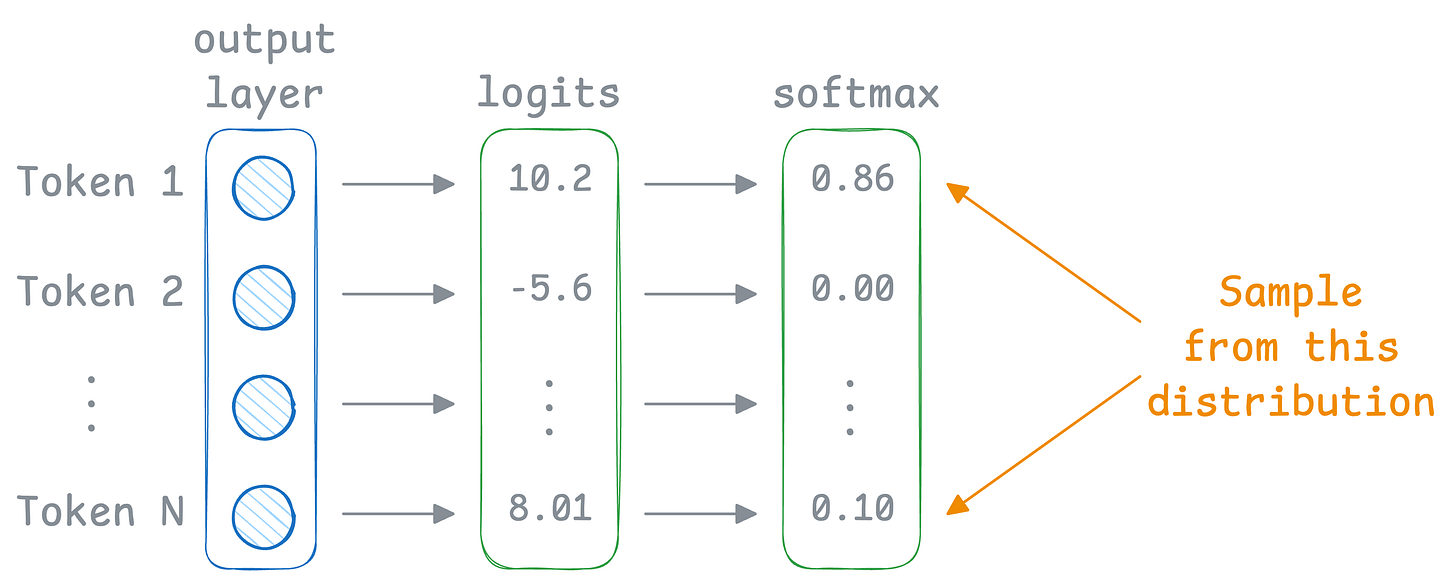
Thus, even though Token 1 has the highest probability of being selected (0.86), it may not be chosen as the next token — since we're sampling, not just picking the max.
This is what makes LLM outputs variable even before temperature enters the picture.
Now, Enter Temperature
Temperature changes the shape of probability distribution before sampling.
Here's the exact tweak it introduces to the softmax function:
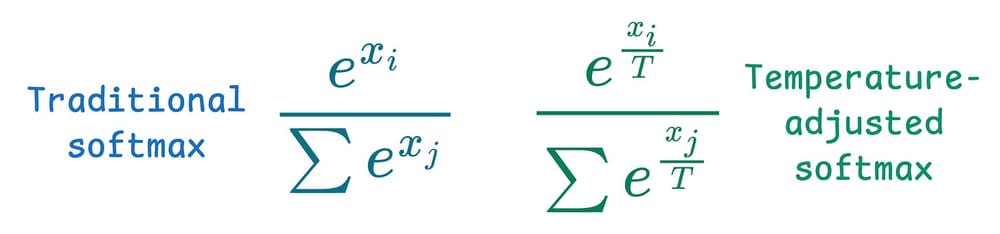
Just one change: divide the logits by T before exponentiating. One letter. One denominator. Dramatic effects.
1) Low Temperature → Peaked Distribution
When T is tiny (say, 0.01):
Python
All probability mass collapses onto the token with the highest logit. The value 1.00e+000 = 1.0, meaning essentially 100% probability.
- This means the sampling process will almost certainly choose the token with the highest probability.
- This makes the generation process look greedy and (almost) deterministic.
2) High Temperature → Uniform Distribution
When T is enormous (say, 10,000,000,000):
Python
The distribution becomes completely flat — every token becomes equally likely.
- This means the sampling process may select any token.
- This makes the generation process random and heavily stochastic.
Welcome to the gibberish we witnessed earlier.
Best Practices
- Set a low temperature for predictable, consistent responses — factual Q&A, code generation, structured output.
- Set a high temperature for more random and creative responses — brainstorming, story generation, ideation.
- An extremely high temperature rarely has real utility — as we saw at the top, it just produces incoherent noise.
A Quick Note (The Catch You Didn't Ask For)
⚠️ In practice, the model can generate different outputs even if
temperature=0. This is because there are still several other sources of randomness, such as race conditions in multithreaded code.
So temperature=0 doesn't mean perfectly deterministic — just as deterministic as reasonably possible.
TL;DR (For The Scroll-Happy)
- LLMs sample from probability distributions — they don't always pick the most likely token.
- Temperature scales the logits before softmax, changing the shape of the distribution.
- Low temperature → peaked distribution → greedy, predictable output.
- High temperature → flat, uniform distribution → random, chaotic output.
temperature=0isn't perfectly deterministic — other sources of randomness still exist.
Final Thoughts
Temperature isn't magic. It's just one division operation buried inside your softmax. A single T sitting in the denominator, quietly deciding how unhinged your model gets.
The next time someone tells you "just set a higher temperature for creativity" — you'll know they mean: make the probability distribution flatter so the sampling gets wilder.
Same thing. But now you actually understand it.
Found this useful? Share it with someone who's been blindly setting temperature=0.7 and hoping for the best.
Further Reading: